
Get Your Personal Consultation
Searching for the right solution?
We are happy to consult with you which solutions best fit your needs.
We are happy to consult with you which solutions best fit your needs.


| Machines | Started with 2 from a previous supplier. Ten Lung Meng draw tape lines added in the past five years alone |
| Line configuration | One single-lane line, then two double-lane lines, then S-Cut, interleaved and T-shirt bag on roll |
| Line speed | Up to 200 m/min (TAR Series); 160 m/min on the TA Series |
| Output capacity | 2–3× the original |
| Unplanned downtime | Several faults a day, down to close to zero |
| Partnership | More than a decade |
| Growth | From scattered orders to nationwide distribution |
| Industry | Household and retail packaging: draw tape refuse sacks, T-shirt bags |
| Market | East Asia |
| Customer base | A national retail network |
| Expansion & Investment | Ten Lung Meng draw tape lines added within five years. A new five-story plant opens in 2027, with five complete production lines newly commissioned |
In flexible packaging, the gap between a converter who is barely holding on and one who supplies a national retail network usually comes down to a single decision: whether the machines hold up. This is the story of one converter’s decision over more than a decade, and what it cost him the first time he got it wrong.
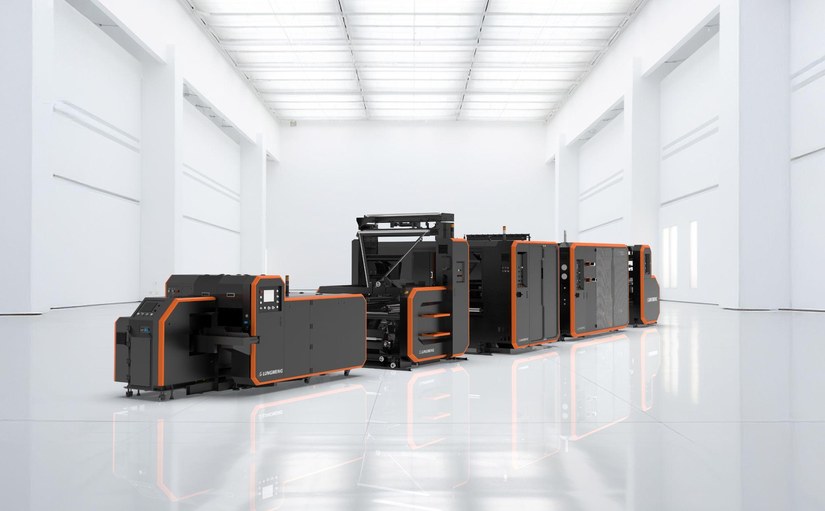
More than a decade ago, Mr. Shen bought two draw tape bag making machines from an unverified manufacturer in Asia, chosen on entry price. Within months they were failing on no fixed pattern: sometimes several times in a single day, on a good run a few days apart. Sensor faults, drive synchronization failures.
Worse than the stoppages was the wait. Getting an answer from the original manufacturer’s engineer online could take one to three working days, and sometimes longer, before the line ran again.
Output quality tracked uptime. The sealing units could not hold consistent temperature and pressure, so side seals split under light load, and the draw tape insertion drifted during running. The returns damaged something slower to repair than a machine.
After two bad machines he was not going to take a third supplier’s word for it, and replacing the whole floor at once was not an option either. So he changed one line and left the second one running. A single Lung Meng draw tape bag on roll converting system took over the first line as a test.
The difference showed in the first production week: seals held, draw tape position stayed inside tolerance, and the line ran a full shift without anyone standing over it.
That first line changed four things on the floor: seal consistency, output capacity, how maintenance was scheduled, and where his skilled people spent the day.
Across shifts, seal integrity and draw tape position stayed consistent enough to ship straight into high-turnover retail without re-inspection.
Two to three times the old output, on the same floor space. Only part of that came from a faster line; the rest came from machines that needed virtually no stoppages for adjustment. Larger contracts on shorter lead times followed.
Heavy-duty construction put maintenance on the calendar instead of the fire-fighting list. Where the previous machines failed several times a day, unplanned stoppages became rare enough that the converter counts them as close to zero.
The level of automation meant operators no longer had to watch the machines continuously, so skilled people went to inspection and logistics instead.
Those four changes are why a second purchase happened at all. He did not buy ten machines at once. He bought one, and each stage decided the next.
| Stage | What he added | Why | What changed |
|---|---|---|---|
| 1 | One single-lane line, replacing the worse of the two existing machines | Change one line first and verify seal and draw tape stability before committing further | Seals held and the line ran a full shift without intervention in the first production week |
| 2 | Two double-lane lines | Orders had outgrown capacity, and expanding the building was not an option | Output capacity reached two to three times the original, and lead times became short enough to bid for national retail contracts |
| 3 | S-Cut, interleaved and perforation functions | Retail buyers began asking one supplier to cover several bag formats | One line, multiple product formats |
| 4 | T-shirt bag on roll | Extend into an adjacent product category for the same customers | A new product line without changing supplier |
Today his plant supplies a national retail network, and he has added ten Lung Meng draw tape lines in the past five years alone. A new five-story plant opens in 2027 with five complete production lines. What made the long-term contracts possible was not the price of the machines. It was that the lines kept running.
If any of these describe your situation, this case is close to yours:
When evaluating a draw tape line upgrade or expanding capacity, converters frequently ask two practical questions:
The TAR Series (model TAR-900C) runs up to 200 m/min, and the TA Series runs at 160 m/min. Which one suits a given plant depends on the product, the target bag format and the rest of the line, so the fit is decided case by case rather than from the speed figure alone.
Yes, and there are two different routes to it. S-Cut, interleaved and perforation are functions added to an existing configuration. T-shirt bag on roll is its own device, added later, which is how this converter opened an adjacent product category without changing supplier.
If you are interested, please feel free to contact us. We will recommend the most suitable machine model for your factory based on your specific requirements.
Related machines
| Product | Model | Line speed | Specifications |
|---|---|---|---|
| Interleaved Draw Tape Bag on Roll Converting System — TAR Series | TAR-900C | Up to 200 m/min | View specifications |
| Interleaved Draw Tape Bag on Roll Converting System — TA Series | TA-1000-IPD-XL-C / TA-1250-IPD-XL-C | 160 m/min | View specifications |
| Shuttle Track Draw Tape Bag On Roll Converting System | TA-1000-PDR-S1 / TA-1250-PDR-S1 | — | View specifications |
Related video
Mr. Shen’s line-up did not grow because a supplier promised more. It grew because the first line he replaced kept running, and every purchase after that was decided by what the previous one had already proved on his floor. If you are weighing the same decision, the place to start is one line, not a whole plant.
Get the Machine Specifications Here!
I have a specific product in mind and want a consultation right away!