Get Your Personal Consultation
Searching for the right solution?
We are happy to consult with you which solutions best fit your needs.
We are happy to consult with you which solutions best fit your needs.


Flexographic printing, or flexo, transfers ink from a flexible photopolymer relief plate onto a moving web, using fast-drying inks. Presses run at speeds up to 600 meters per minute, roughly 2,000 linear feet per minute. It prints labels, flexible packaging, corrugated board and paper cups on both porous and non-porous substrates. For plastic film packaging it is the dominant process.
That definition appears on every page you will find about flexo. Harder to find is the part that matters when you are specifying a press: each step of the process sets a specification on the machine. Plate thickness governs mounting tolerance. Ink chemistry governs dryer length. Web tension governs register accuracy at speed. This guide walks the process step by step, and names the machine specification each step decides.
Flexography is a relief process, the modern descendant of rotary letterpress. The image sits raised on a flexible photopolymer or rubber plate, and only those raised areas carry ink. The press meters ink through an anilox roller: a hard cylinder engraved with thousands of tiny cells, each holding a fixed volume. A doctor blade wipes the surface clean so only the cells stay filled.
That metering is what keeps the ink film consistent from the first meter of a run to the last. The anilox transfers it to the plate, the plate meets the substrate against an impression cylinder, and the web moves on to drying. Because the plate is flexible and the ink dries fast, flexo handles substrates that rigid processes struggle with: polyethylene film, laminates, kraft, corrugated board, foil. That range, plus fast plate changes, is why it dominates packaging rather than commercial print.
Most explanations of flexo stop at describing the six steps. This section adds the second half: what each step demands of the machine you are specifying.
Artwork is separated by color, and each separation is imaged onto a photopolymer plate. Today that is almost always done by direct laser ablation of a black mask layer, followed by ultraviolet (UV) exposure and washout. Plates come flat, or as seamless in-the-round (ITR) sleeves.
What it sets on the machine: plate thickness and hardness determine the impression setting range the press has to accommodate. A thicker plate is more forgiving of substrate variation but spreads dots more under pressure, so the press needs finer impression adjustment to stay in the useful window.
Each plate is mounted onto its cylinder or sleeve with double-sided tape, aligned to register marks. On a multi-color job this is repeated for every station.
What it sets on the machine: mounting accuracy is the ceiling on register accuracy: the press cannot hold tighter register than the plates were mounted to. When you read a register specification on a datasheet, ask at what web speed and on what substrate it was measured. Those two conditions move the number more than the press design does.
The anilox is specified by two numbers: line screen, measured in lines per inch (LPI), and cell volume, measured in billion cubic microns per square inch (BCM). Together they fix how much ink reaches the plate.
A fine screen lays down a thin, controlled film suited to small type and fine screens; a coarse screen carries more ink for solids and heavy coverage.
What it sets on the machine: the anilox has to be matched to the ink system and the substrate, not chosen in isolation. A press bought with one anilox set for solid-color film work will not run fine process images without a different roller, and anilox rollers are not a cheap afterthought.
The web unwinds, passes every print station under controlled tension, and rewinds. Tension has to stay inside a window: too little and the web wanders, too much and film stretches. A stretched film prints in register at the start of the run and out of register by the end.
What it sets on the machine: the tension control specification is set by the thinnest, most extensible material you intend to run, not the average one. Film has a far narrower tension window than paper or board, and thin polyethylene is the narrowest case most packaging converters will meet.
Not sure which of your materials sets the limit? The film thickness and web width you run today are enough for us to work it out with you.
The plate cylinder and the impression cylinder close on the web, and ink transfers where the raised areas make contact. The pressure required is far lower than letterpress. Flexo works on "kiss impression": the lightest contact that still transfers a full ink film.
What it sets on the machine: over-impression is the most common cause of dot gain, and it usually comes from operators compensating for something else: a worn plate, a drifting anilox, an inconsistent web. Presses that make impression easy to set repeatably, and easy to return to a known setting after a changeover, lose less time to this.
Ink is dried or cured between stations and again before rewind. Solvent and water-based inks dry by evaporation and need heat and airflow; ultraviolet (UV) and electron beam (EB) inks cure by radiation almost instantly.
What it sets on the machine: the ink system decides the drying section, and the drying section decides the machine's footprint. Water-based inks on film generally need more drying energy and more dwell time than solvent.
That means a longer machine for the same line speed. Choosing water-based ink for environmental or regulatory reasons is a legitimate decision, but it is a decision about floor space as much as about chemistry.
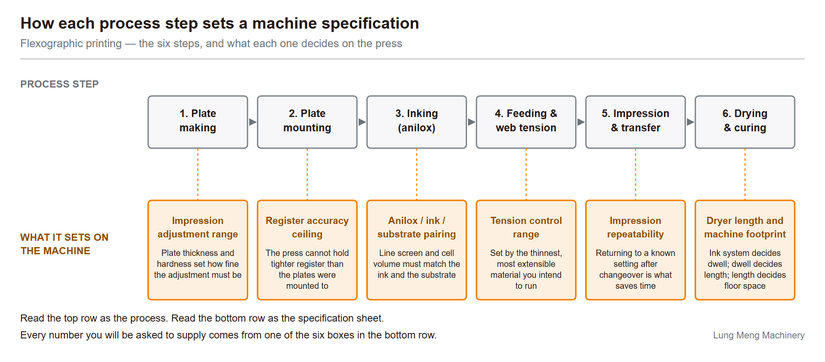
(Read the top row as the process and the bottom row as the specification sheet. Every number a supplier will ask you for comes from one of the six boxes.)
Two decisions made before the press is specified will constrain it for its whole life.
| Flat plates | ITR sleeves | |
|---|---|---|
| Up-front cost | Lower | Higher |
| Lead time | Shorter | Longer |
| Register | Depends on mounting accuracy each time | Repeatable, no re-mounting |
| Seamless printing | Not possible | Possible (continuous patterns) |
| Suits | Frequent short runs, many stock keeping units (SKUs) | Long runs, continuous designs, tight register |
| Solvent-based | Water-based | UV | EB | |
|---|---|---|---|---|
| Adhesion on film | Widest substrate range | Good with surface treatment | Good | Good |
| Drying need | Heat + airflow | More heat, more dwell | UV lamps, minimal dwell | EB unit, no dwell |
| Effect on machine length | Moderate | Longest | Short | Shortest |
| Regulatory friction | Volatile organic compound (VOC) handling required | Lowest | Photoinitiator migration limits | Low, high capital |
A recurring conversation with buyers who already run flexo: something cannot be done, and it is not clear whether the process cannot do it or this particular press cannot do it. The two have completely different answers: one means change technology, the other means change or upgrade equipment.
| Symptom | Usually the process | Usually the machine |
|---|---|---|
| Very fine highlight dots dropping out | Flexo's dot range is narrower than gravure's | |
| Line speed capped well below rating | Drying capacity, not the print units | |
| Register drifting through a long run | Tension control, or plate mounting | |
| Solid ink density inconsistent across the web | Anilox wear or impression setting | |
| Photographic-quality continuous tone | This is where gravure still wins |
If you already extrude your own film and are considering bringing printing in-house, the printing press is not the only decision. The handover between the two lines is where most of the surprises live.
Four questions decide whether that handover is straightforward or expensive:
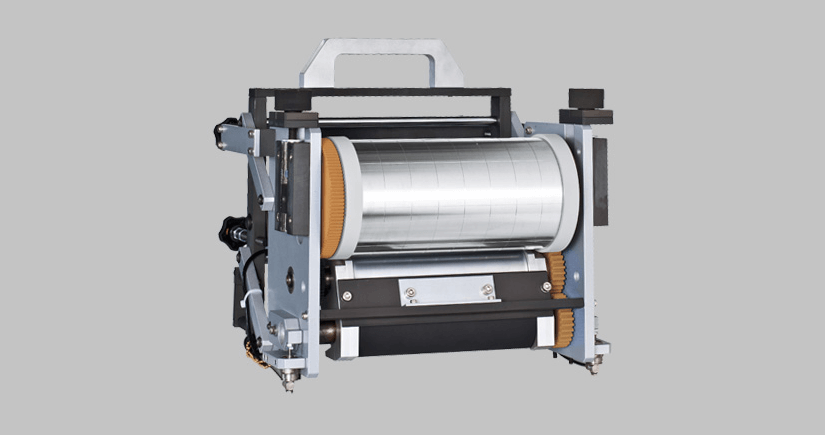
Lung Meng builds both sides of that handover: blown film lines from mono-layer to five-layer, and flexo presses. The Mini Portable Type flexographic printing machine attaches directly to a blown film or bag making machine, with no separate electrical connection.
No answers to those four yet? Tell us which blown film line you run and we will work through them with you.
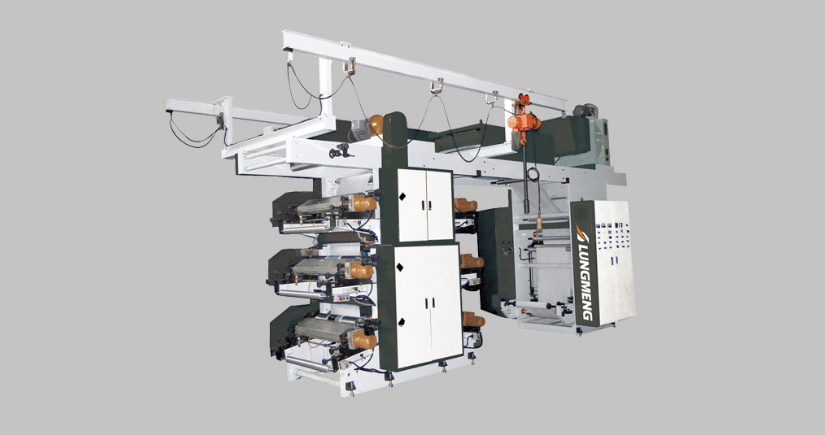
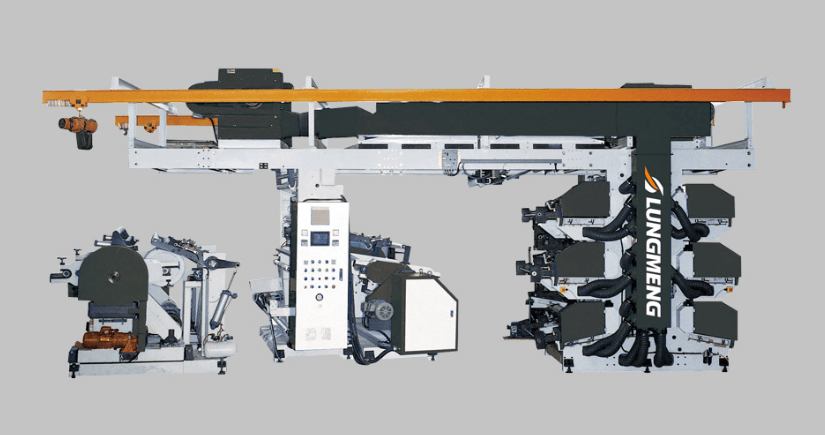
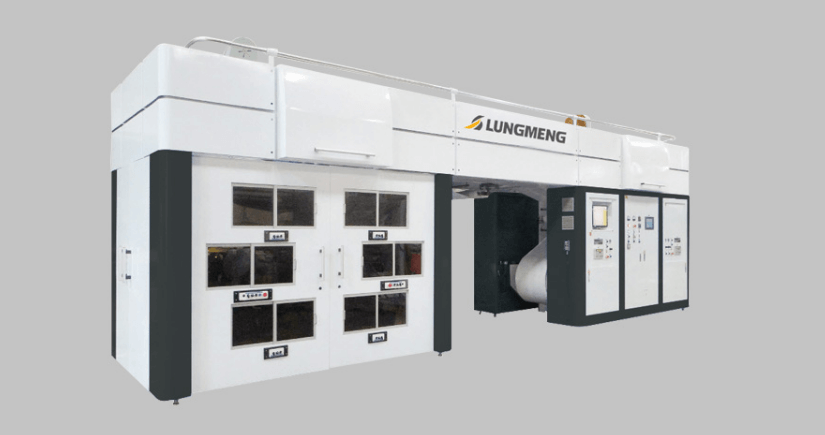
Three architectures dominate, and each one is a different answer to the register question.
See the high speed C.I. flexographic printing press and the high speed six color flexographic printing machine, or the full printing machine range.
Which one fits depends on your run lengths, substrate and color count. If you are choosing a press rather than learning the process, our plastic printing machine buyer's guide compares flexo with gravure and digital and walks through Lung Meng's four flexo models.
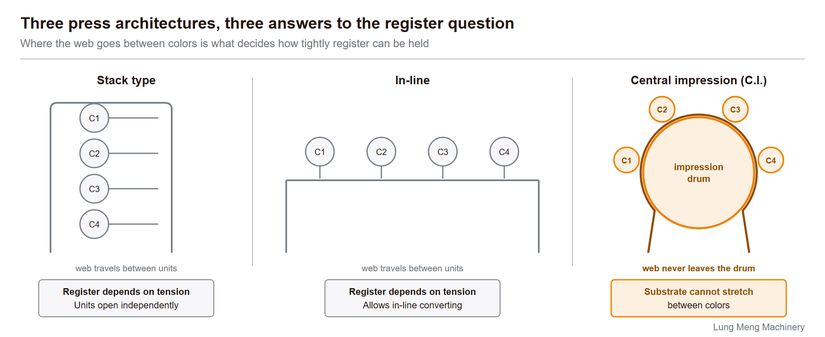
(Where the web goes between colors is what decides how tightly register can be held.)
Lung Meng builds four flexographic presses, from a mini portable unit that attaches to a blown film line to a central impression press rated at 300 m/min, and each one answers the six specifications above with specific hardware.
| Process step | What it sets on the machine | What Lung Meng builds in |
|---|---|---|
| 1. Plate making | Impression setting range | Hydraulic plate roller lifting and lowering (High Speed Six Color) |
| 2. Plate mounting | Register accuracy ceiling | Gear-driven color registration system (High-speed Central Impression Drum); 360° planetary gear color registration system (High-speed 6-color) |
| 3. Inking | Anilox, ink and substrate pairing | Ceramic anilox roller + Doctor blade system + Pneumatic ink circulation system |
| 4. Web tension | Tension control range | Fully automatic tension control for unwinding and rewinding (Stack-type, High-speed 6-color); Edge Position Control (EPC) (High-speed 6-color, High-speed Central Impression drum) |
| 5. Impression (Optional) | Impression repeatability | Precision central drum impression roller and photo video inspection with a full-color monitor for setting (High Speed C.I.) |
| 6. Drying | Dryer length and footprint | Electric hot air dryer with temperature control (High Speed Six Color) |
These are the questions that come up most often once the process is clear.
A photopolymer plate typically runs 250,000 to 1,000,000 impressions before quality degrades. Substrate abrasiveness, ink system and impression setting all move that figure. Plates are stored and re-run for repeat jobs.
UV cures by radiation almost instantly and needs minimal drying length; solvent dries by evaporation and needs heat, airflow and dwell. See the ink comparison above. The practical consequence is machine length.
The ink system and the target line speed together. Water-based inks on film need more drying energy and more dwell than solvent, so at the same speed they need a longer machine. This is why the ink decision belongs before the press decision, not after.
Metric and imperial conventions persist in different markets. 600 m/min is roughly 2,000 linear feet per minute. When comparing datasheets, check the unit before comparing the number.
Crew size is set by changeover frequency more than by press size. A line running long jobs with few changeovers can be held by one operator plus a shared assistant. A line changing jobs several times per shift needs a dedicated operator plus help during each changeover, because plate changes and wash-ups happen in parallel.
Automated plate mounting, motorized impression setting and pre-mixed ink supply are the features that move the number down.
The dryers, not the drives. Motors and web handling draw a modest and fairly constant load; drying is where the variable energy goes, which is why the ink decision drives running cost as well as machine length.
Solvent and water-based systems need heated air and extraction, and water-based needs more of both. UV and EB curing replace hot air with lamp or emitter power, which changes the shape of the load rather than removing it.
Relative to the alternatives it is favorable: low ink waste through anilox metering, short make-ready, and water-based and UV systems that avoid solvent emissions. The trade-off is that the lower-emission ink systems generally need a longer drying section.
Every step above ends in a number that belongs on a specification sheet. What this guide cannot do is tell you which numbers your line needs. That depends on the film you run, the width you print, and the speed your downstream converting can absorb.
No article can answer that. A press specification is a set of trade-offs against your existing line, not a lookup.
Tell us four things and our engineers will come back with a machine configuration and the reasoning behind it: the substrate and film thickness you run, your web width, your color count, and your target line speed. Put them in the enquiry form. The Comments field is fine, no special format needed.
Already running a flexo press and trying to work out whether a limit is the process or the machine? Say which press and which symptom in the same form. That is a different conversation from a new-line enquiry, and it goes to a different engineer. Please contact us today!